Studies
Delegate to Innovate: Why Acquisition Reform Alone Can’t Fix Military Innovation (And How to Succeed Anyway)
The slow pace of American military innovation presents an urgent problem for U.S. policymakers, but recent Department of Defense (DoD) acquisition reforms do not address the deeper problem slowing down defense innovation: decentralized decision-making authority and accountability across the department. This diffusion of responsibility for innovation produces delay, cost growth, and failure to meet operational specifications.
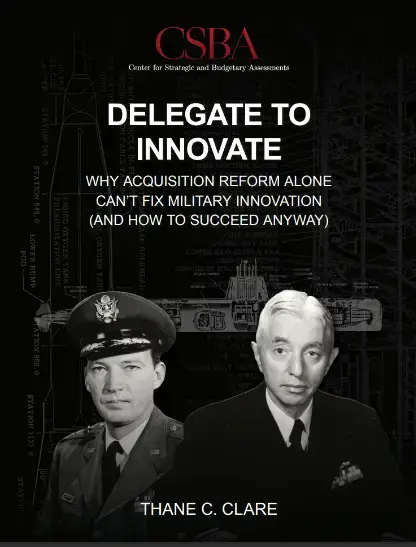
In Delegate to Innovate: Why Acquisition Reform Alone Can’t Fix Military Innovation (And How to Succeed Anyway), Senior Fellow Thane Clare argues that innovation succeeds when leaders are delegated principal authority to plan, prioritize, and act without the friction of bureaucracy. The causes of defense innovation failure stem from decentralized authority, uncoordinated decisions made with incomplete information, and competing institutional pressures, among others. The DoD’s previous solutions of process reform, culture shifts, innovation incubators, and direct-report program managers have proven unsuccessful. This study proposes that the most effective model is “delegate to innovate,” which identifies a clearly defined solution to a pressing operational problem and arms a single subordinate with a tailored team and all the necessary authorities to develop, produce, and field that solution.
Clare illustrates this argument with examples from America’s Cold War that demonstrate how empowered innovators protected from normal bureaucratic processes were able to innovate quickly, effectively, and at scale. Admiral Hyman G. Rickover, the driving force responsible for the nuclear submarine, achieved authority over every aspect of nuclear power and vested it in establishing the foundation of naval striking power. General Bernard Schriever, once placed in charge of the Atlas ICBM program, circumvented bureaucratic delays and successfully fielded missiles within five years. These innovators, the organizations they led, and the senior leaders who delegated unprecedented authority to them are models for the future of defense innovation.