Studies
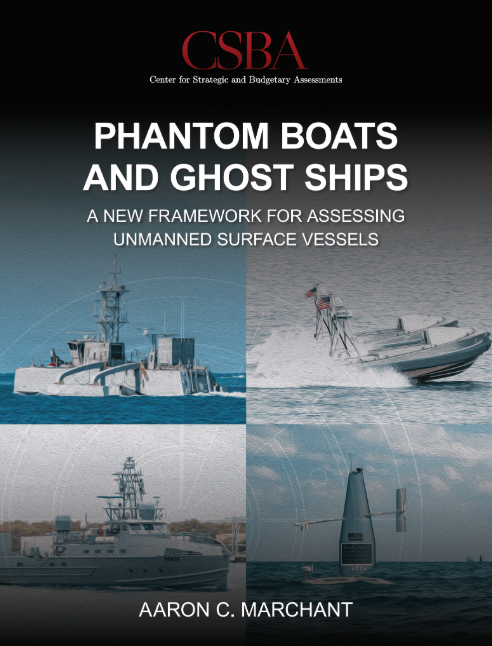
Phantom Boats and Ghost Ships: A New Framework for Assessing Unmanned Surface Vessels
By adopting unmanned surface vessels (USVs), the U.S. Navy has an enormous opportunity to increase its lethality across a variety of scenarios. However, without a clear concept of operations (CONOPS), the Navy risks investing in USVs that are not suitable to its mission demands, or worse, that are counterproductive to achieving its strategic goals. It is imperative, therefore, that the Navy articulates a cogent strategy for how it plans to employ USVs, starting with clear requirements for the different kinds of USVs it plans to develop and build.
Much of the discussion about USV CONOPS, employment, and force structure is confused because there is ambiguity about what USVs are and how they should be used. In Phantom Boats and Ghost Ships: A New Framework for Assessing Unmanned Surface Vessels, Commander Aaron Marchant seeks to help the U.S. Navy articulate its strategy for employing USVs in the fleet by developing a new framework for categorizing them, assessing USVs based on the types within this framework, and providing recommendations. The Navy has classified its developmental USVs in terms of their size or their task, but Marchant proposes a framework that better characterizes the role they would play in the Navy’s force architecture. He categorizes USVs based on where they lie across two axes, longevity versus functionality, which then creates four types of USVs: Nonexpendable Offensive USVs, Expendable Strike Platforms, Support Ships and Auxiliaries, and Expendable Support Craft. Marchant argues that the four quadrants of this new framework can help explain how USVs could contribute to the U.S. Navy’s force structure, which would in turn help strategists understand the best USVs to employ for certain naval missions and by extension the best USV concepts to employ against different threats.
Marchant illustrates this framework’s utility by providing detail on the kinds of vessels that fall into his matrix’s categories, assessing the naval mission areas each category would most optimally contribute to, and conducting a risk/reward assessment of each type of USV compared with a manned alternative. He demonstrates that in order to best take advantage of USVs in the fleet, the U.S. Navy needs a conceptual framework that gets to the essence of what USVs will do and how they will fit into the force.