 Back
BackResearch & Analysis
CSBA held a webinar discussion on Strengthening the Phalanx: Layered, Comprehensive, and Distributed Air and Missile Defense in the Indo-Pacific, by Carl Rehberg and Herbert Kemp.

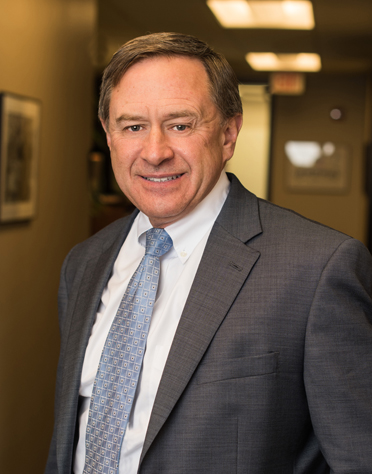
Dr. Carl Rehberg is a Non-resident Senior Fellow at the Center for Strategic and Budgetary Assessments.
Carl was founder and director of the Headquarters Air Force Asia-Pacific Cell, which played a pivotal role in the development of Air Force strategy, force development, planning, analysis and warfighting concepts supporting initiatives related to Asia-Pacific and the DoD Third Offset Strategy. Carl spearheaded the establishment of the China Aerospace Studies Institute (CASI) and led the development of innovative concepts and capability proposals to improve DoD’s joint resiliency and integrated air and missile defenses. Prior to this assignment, he was the Assistant Associate Director for AF Strategic Planning and Director, Analysis Division in the AF QDR organization, leading multiple assessments of future capabilities and force structure.
During his 26+ year Air Force career, Carl served as a command pilot with over 6200 hours flying time in 25+ different aircraft including the KC-135, B-1B, TG-7, and T-3A. He taught Military Art and Science at the USAF Academy, and was instrumental in helping form the USAF Academy Center for Character Development. In the late 1990s, he served in the Pentagon as a strategic planner, programmer and analyst, leading several studies for the Secretary of Defense on the Total Force. In 2001, Carl was selected as a National Security Fellow at Harvard and then spent two years at the National Defense University’s Industrial College of the Armed Forces (ICAF) teaching courses in grand strategy, military mobilization, and the aircraft industrial base. As Chief, Long-Range Plans of the Air Staff, Carl led the development of future force structure plans and courses of action for numerous AF/defense resource and tradespace analyses.

CSBA held a webinar discussion on Strengthening the Phalanx: Layered, Comprehensive, and Distributed Air and Missile Defense in the Indo-Pacific, by Carl Rehberg and Herbert Kemp.
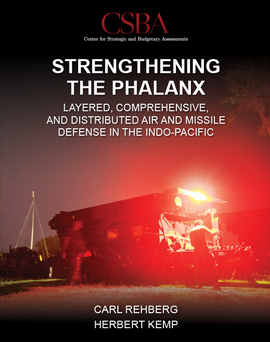
Carl Rehberg and Herbert Kemp outline a layered, comprehensive, and distributed integrated air and missile defense designed in concentric rings as a high-capacity and cost-effective active deterrent against great power aggression. The authors apply this system to the defense of Guam to explore how it could strengthen U.S. power projection.
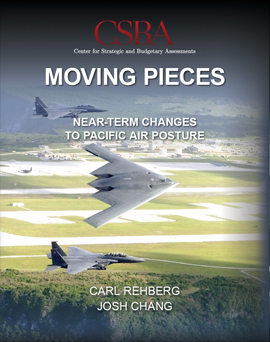
Carl Rehberg and Josh Chang argue that the current posture of U.S. Indo-Pacific air forces is insufficiently resilient against the increasing threat from China. They propose a new framework with an emphasis on force structure capabilities for counterstrike, using Okinawa and Guam as case studies for examining force posture resiliency.
As the deadly Russia-Ukraine conflict moves to new phases, the U.S., its allies, and partners must heed critical and emerging insights from this hot war. After more than one hundred days of high-intensity conflict, some clear and compelling initial insights for the U.S. and Allied Integrated Air and Missile Defense (IAMD) are emerging. The effectiveness of IAMD systems in countering both missiles and Unmanned Aerial Systems (UAS) have been critical elements in this conflict–with a continued evolution in competition between fires and the defender. A clear understanding of these dynamics and the key lessons they provide will be vital for the U.S. and its allies to mitigate capability and capacity shortfalls while enhancing and revising operational approaches in Europe, the Indo-Pacific, and elsewhere around the globe. These are initial insights and preliminary lessons learned, developed using open-source information, so additional insights and revisions are expected later, with the benefit of in-depth evaluation(s) and more complete data.
On June 18, 2024, CSBA held a webinar discussion on Strengthening the Phalanx: Layered, Comprehensive, and Distributed Air and Missile Defense in the Indo-Pacific, by Carl Rehberg and Herbert Kemp. The event included remarks from the authors, commentary by Ambassador Eric Edelman, and a Q&A moderated by Dr. Thomas G. Mahnken.
1667 K Street NW Suite 900
Washington DC, 20006
202-331-7990
info@csbaonline.org

